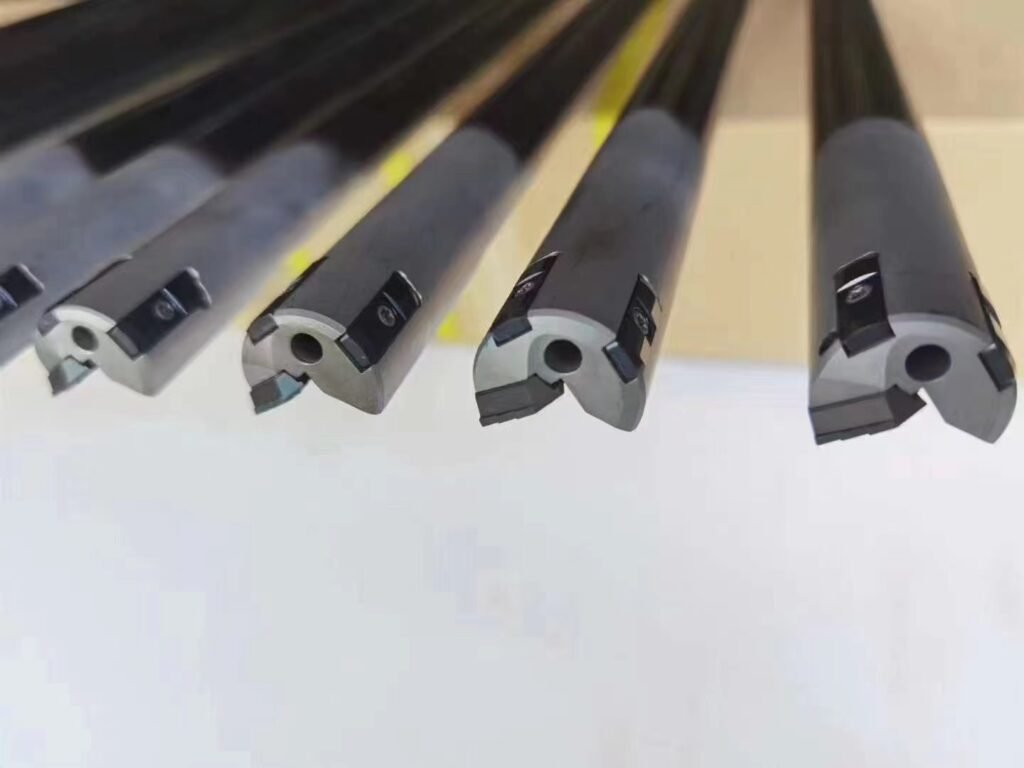
Gun drilling is a specialized deep hole machining process widely used to manufacture precision deep holes in metal workpieces. Successful gun drilling heavily relies on reliable chip control, because poor chip handling is one of the most frequent failure sources in gun drilling operations. Improper chip formation in gun drilling can cause chip blockage, bird-nesting chip wrapping, scratched hole inner surfaces, accelerated gun drill insert wear, poor dimensional accuracy, and even sudden gun drill breakage. For CNC operators and machinists, analyzing chip conditions in gun drilling and applying targeted fixes is essential to stabilize gun drilling production, extend gun drill service life and improve finished hole quality. Two most typical chip-related defects during gun drilling are chip blockage and chip wrapping (bird-nesting).
- Phenomenon: Chip Blockage in Gun Drilling
Chip blockage in gun drilling means metal chips cannot flow out smoothly through the gun drill’s chip evacuation channel and accumulate inside the deep machined bore. Packed chips will be recut by the gun drill, damaging the hole surface and jamming the gun drill.
Main causes and solutions for gun drilling chip blockage:
(a) Low oil pressure of the gun drilling cooling system. Solution: Set and adjust coolant oil pressure matching the hole diameter for your gun drilling setup.
(b) Insufficient oil volume for gun drilling. Solution: Deliver enough coolant flow corresponding to the machined hole size; inspect cutting oil and confirm whether excessive oil viscosity slows down fluid circulation and weakens chip flushing in gun drilling.
(c) Undesirable chip morphology in gun drilling. Solution: When using gun drilling on hard workpieces, properly reduce the feed rate; select the correct gun drill insert shape and cutting angles to achieve stable chip breaking.
(d) Mechanical structure limitations. Solution: Optimize equipment layout and enlarge the chip evacuation space for gun drilling. - Phenomenon: Chip Wrapping (Bird-nesting) in Gun Drilling
Bird-nesting occurs when long continuous chips twist tightly and wrap around the gun drill during gun drilling. This defect blocks internal coolant delivery, wears the gun drill cutting edge quickly and interrupts continuous gun drilling machining.
Main causes, inspection and adjustment methods for gun drilling bird-nesting:
(a) Stringy chips in gun drilling. Adjustment and inspection methods: Increase feed rate to promote chip breaking; check excessive outer corner wear on the gun drill; inspect nicks on the gun drill outer corner or outer cutting edge. Use a fine-grit grinding stone during gun drill regrinding. If stringy chips emerge during center hole machining with gun drilling, raise cooling oil pressure and lower the feed rate.
(b) Wrinkled or folded chips in gun drilling. Inspection methods: Check whether there are nicks on the gun drill cutting tip and nearby cutting edges; tiny edge nicks deform chips and trigger irregular folding in gun drilling.
For practical gun drilling production, machinists should continuously observe chip conditions in real time. Optimizing gun drilling is not about changing only one variable; technicians need to comprehensively tune gun drilling cutting parameters, coolant specifications and gun drill tool status. Only with systematic chip management can manufacturers achieve consistent chip breaking and smooth chip evacuation in gun drilling.